
Termites, general pest, mosquitoes, rodents
Know what’sin your housebefore you sign
Red clay holds water long after the rain stops, and that one fact drives nearly every pest problem in this city. Work out what you are actually dealing with, then decide who to call.
✓Problems sorted by what you are seeing and where
✓Checks you can run yourself before anyone comes out
✓What a real proposal contains, so you can judge one
Find your problemBrowse by house age
Need a pro now?
Connects you with a licensed local company. How this works.
If one of these is happening right now, deal with it before you read anything else.
Winged insects inside in spring mean a colony is already in the structure, not nearby. Collect a few in a jar before they are vacuumed up.
Pencil-width earth tubes climbing the block mean termites are traveling right now. Leave them intact so an inspector can read them.
There are very probably young up there too. Do not seal the entry before someone checks, or you trap them inside the wall.
Sustained humidity under a floor is the strongest predictor of termite activity here. The water has to be fixed before any treatment is worth buying.
Termite, general pest, mosquito, rodent and wildlife
Marietta, Kennesaw, Acworth, Woodstock, Mableton and more
Georgia’s termite risk rating — the highest tier issued
The company doing the work sets the figure, so we do not
On this page
1 What are you seeing?
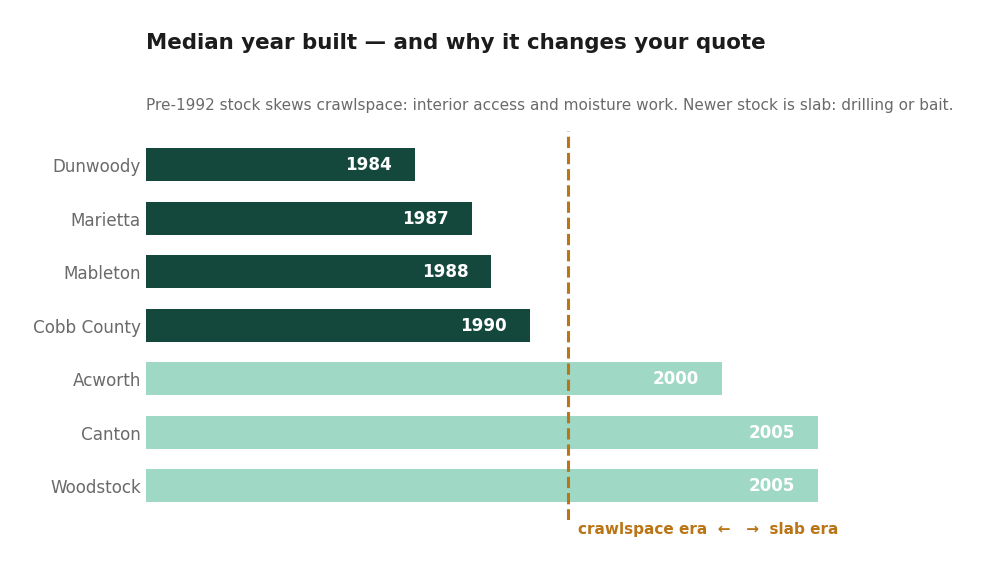
Start with the thing in front of you. Each area lists the problems by the symptom you actually notice, because a 1978 crawlspace house and a 2005 slab house fail in completely different ways.
Mud tubes, discarded wings on a sill, hollow-sounding trim, a spring swarm indoors.
Trails along the counter, roaches in the wet wall, odorous house ants after rain.
Daytime biting in your own yard, standing water you have not found yet.
Scratching overhead at night, droppings in the attic, a gnawed soffit return.
2 By the age of your house
Older does not mean worse. It means a different set of failures. Find the era your house was built and open the service you need.
| Built | Termite | General | Mosquito | Rodent |
|---|---|---|---|---|
| Before 1960 Intown Marietta. Shallow crawlspace, piers, wood close to soil. | Termite | General | Mosquito | Rodent |
| 1960 to 1985 The county median. Crawlspace, block vents, mature canopy on the roof. | Termite | General | Mosquito | Rodent |
| 1985 to 2000 Vinyl soffit returns, detention ponds, first-generation slab-on-grade. | Termite | General | Mosquito | Rodent |
| Since 2000 Woodstock and north Canton. Slab, builder pretreatment that may have lapsed. | Termite | General | Mosquito | Rodent |
3 What a proper job looks like
Most homeowners in Marietta meet pest control the same way: something appears in the kitchen, a company comes out, somebody sprays, and the problem is quiet for a few weeks. That cycle is not treatment. It is suppression, and it repeats because nothing about the conditions that produced the insect has changed.
A crew doing the job properly spends most of its first visit outside the building. They are reading the grade — which way water runs when a summer storm drops two inches in forty minutes. They are looking at where mulch sits against siding, where a downspout empties beside the foundation, where a crawl vent is blocked, where wood meets soil. In this county those details are the job. The chemistry is the easy part.
A thorough first visit includes a full exterior perimeter inspection; entry into the crawlspace if there is one, with a moisture reading; a check of the sill plate and band joist; identification of the actual species rather than “ants”; a written list of conducive conditions you can fix yourself; and a plan that says what is applied, where, and on what cadence. Ask for it in writing. General pest control across Cobb County.
Every page on this site opens by saying what is most likely going on and where the problem sits.
Conditions are listed in the order you should check them, because they get harder as you go down the list.
Most of them take a few minutes, a flashlight and a dry afternoon.
Each page says what a real written proposal contains. If it is a job you can do yourself, the page says so.
4 Crawlspace or slab
Marietta is an old city with a young edge. The streets around the Square, the mid-century neighborhoods off Roswell Road and most of west Marietta are crawlspace construction. Push north and east into the newer subdivisions and you start finding slab. The median home here was built in 1978; ten miles north in Woodstock it is 2005. That is two genuinely different pest problems inside one market.
On a crawlspace home the inspector can see almost everything, provided they are willing to go under the house. Mud tubes climb the piers in plain sight, damage to joists is visible, moisture is measurable. The flip side is that a crawlspace is a humid void sitting directly on clay, and sustained humidity under a floor is the best predictor of termite activity within a few seasons. Moisture correction often has to come first.
On a slab home almost nothing is visible. Termites come up through expansion joints, plumbing penetrations and hairline cracks, and the first sign is usually damage to door frames or baseboards. There is no void to inspect, so the inspector reads the perimeter and infers.
If a company has not asked which one you have before quoting, they are not quoting your house. They are quoting an average.
Talk to someone
Want someone to actually look at it?
Say what you are seeing and where you are. You get routed to a licensed company that works your part of Cobb County, and you get a plan and a number before anyone schedules anything.
Call now
Licensed Georgia operators · No obligation
5 Termites, and why Georgia is Zone 1

Metro Atlanta sits on Piedmont red clay. It holds water far longer than the sandy soil south of the fall line, and that extended moisture window is what lets eastern subterranean termite colonies forage year round here instead of seasonally. Georgia is rated Termite Infestation Probability Zone 1 — “very heavy” — the worst rating the map issues.
Swarm season runs March to May. On a warm, still afternoon after rain, winged reproductives leave the colony, fly badly, drop their wings and die in windowsills. Those discarded wings matter: a swarm inside the building means a colony is already established in or under the structure, not nearby.
Two treatment families, and they are not interchangeable. A liquid soil barrier means trenching and rodding the soil around the full foundation, drilling through slabs and porches where the barrier has to continue, and applying a non repellent termiticide so foragers pass through it and carry it back. Done properly it is a continuous, unbroken treated zone. Done lazily it is a trench on the three easy sides and nothing where the deck is in the way.
A bait system installs in-ground stations that termites find on their own, carrying a growth regulator back to the colony. It is slower, and it depends entirely on somebody servicing the stations on schedule. Neither approach is universally better — it comes down to your foundation, your access, and whether anyone will still be monitoring the property in year three. Termite control across Cobb County.
6 The Georgia termite letter
If you are buying or selling in Marietta, somebody will ask for a termite letter. The real name is the Official Georgia Wood Infestation Report, and it is far narrower than most people assume. It is a licensed inspector’s opinion, on a specific date, about visible evidence of wood destroying organisms in the accessible areas of the structure.
Those two qualifiers are where closings go wrong. Visible evidence means nothing behind finished walls counts. Accessible areas means a crawlspace with eighteen inches of clearance and standing water can be reported as inaccessible, and whatever is under there is simply not covered. A clean letter on a house with an inaccessible crawl tells you much less than the buyer thinks.
The report separates active infestation, previous infestation and damage. Previous evidence with no activity is extremely common in a Zone 1 state and is not by itself a reason to walk away. What matters is whether the damage was repaired, whether the structure was treated, and whether there is a transferable bond. The bond is a separate contract from the inspection — some cover retreatment only, some include repair of new damage with a cap. More on termite work and bonds.
7 Ants and roaches
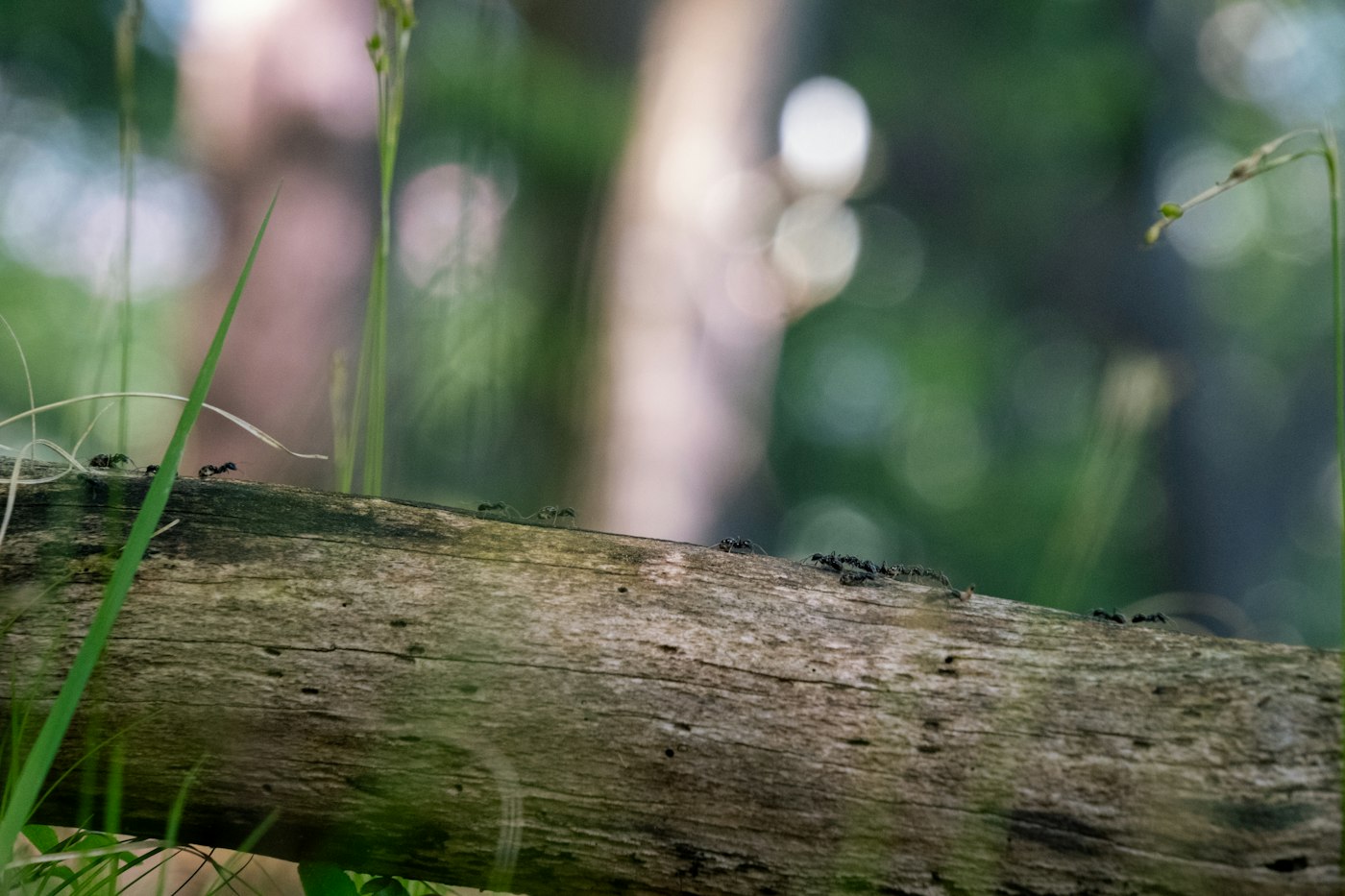
Odorous house ants are the signature nuisance of a Marietta spring. Crush one and it smells faintly of rotten coconut, which is how you tell them from the rest. They nest in wall voids, under slabs, in mulch and in wet insulation, and they move indoors when it rains or when it gets hot and dry — both of which happen constantly here.
Carpenter ants are the ones worth taking seriously. They do not eat wood, they excavate it to nest, and they overwhelmingly choose wood that is already damp. A carpenter ant problem is nearly always a moisture problem in disguise: a leaking shower pan, a failed flashing detail, a roof valley that has been dripping into a wall for two years. Kill the ants, leave the leak, and you will be back.
German cockroaches are a separate discipline. They live in the kitchen and bath wet walls, breed faster than casual treatment can keep up with, and are largely unbothered by spray-and-leave. Gel bait placed where they actually harbor works. The regional cadence is a quarterly exterior perimeter treatment, because north Georgia has no dormant season, only a slower one. General pest control across Cobb County.
8 Mosquitoes
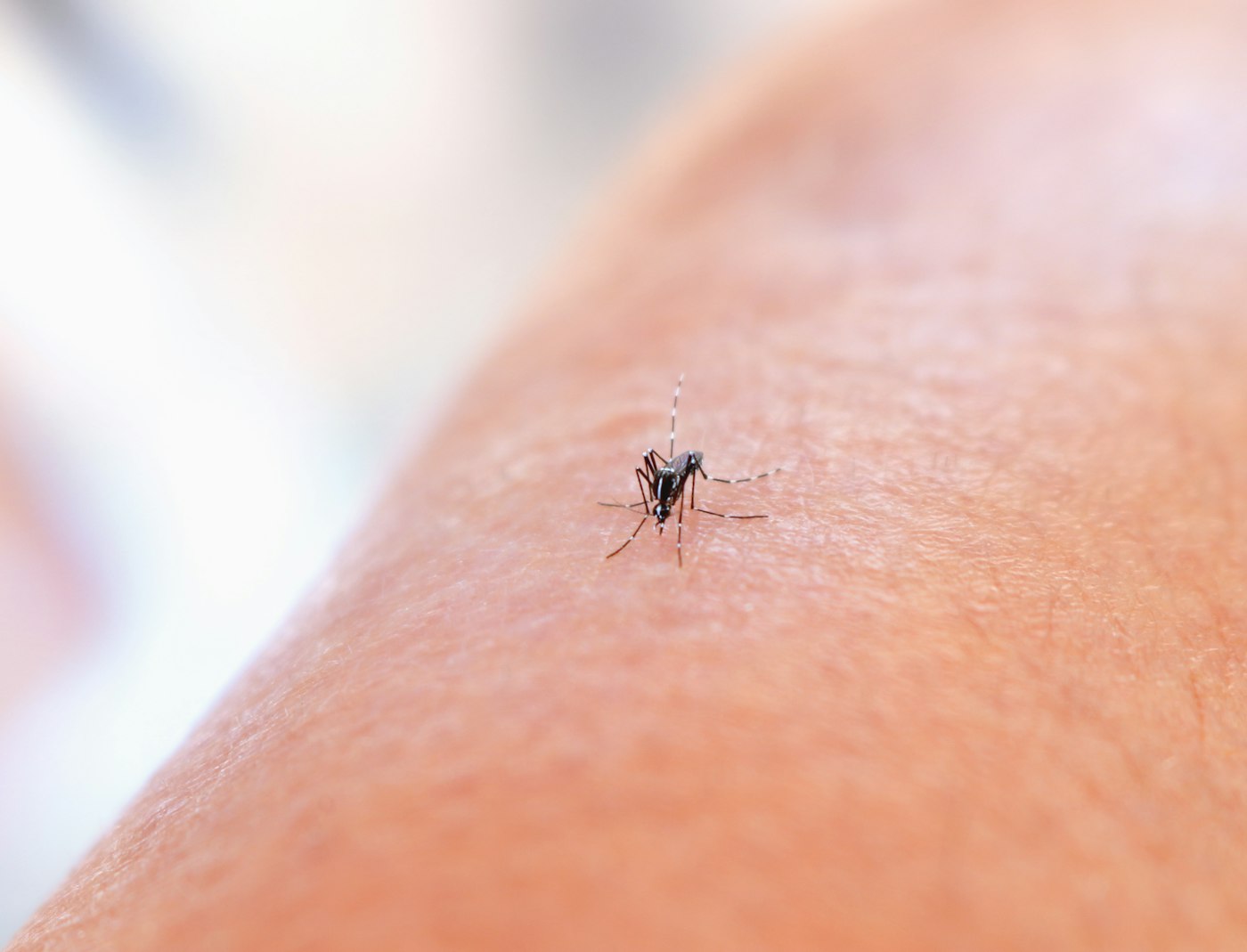
The species ruining your evenings is almost certainly the Asian tiger mosquito. It is a container breeder, it bites during the day, and it does not travel far — which is the useful part. If you are being bitten in your own yard, the water producing them is in your yard or next door, not at the creek down the hill.
A container is anything holding water for about a week: a clogged gutter, a saucer under a pot, a corrugated downspout extension, a tarp fold, a bird bath, a tire, the sump in an unused fountain. A lidless recycling bin left out in June will produce mosquitoes by July.
Barrier treatment is a residual applied to the undersides of foliage and other shaded resting sites. It works, for roughly three to four weeks. What it cannot do is outpace a breeding source you have left in place. A crew worth hiring walks the property, tells you which containers to dump, and then treats. Properties backing onto Sope Creek or Nickajack Creek run a longer season than the rest of the city. Mosquito control across Cobb County.
9 Rodents and wildlife
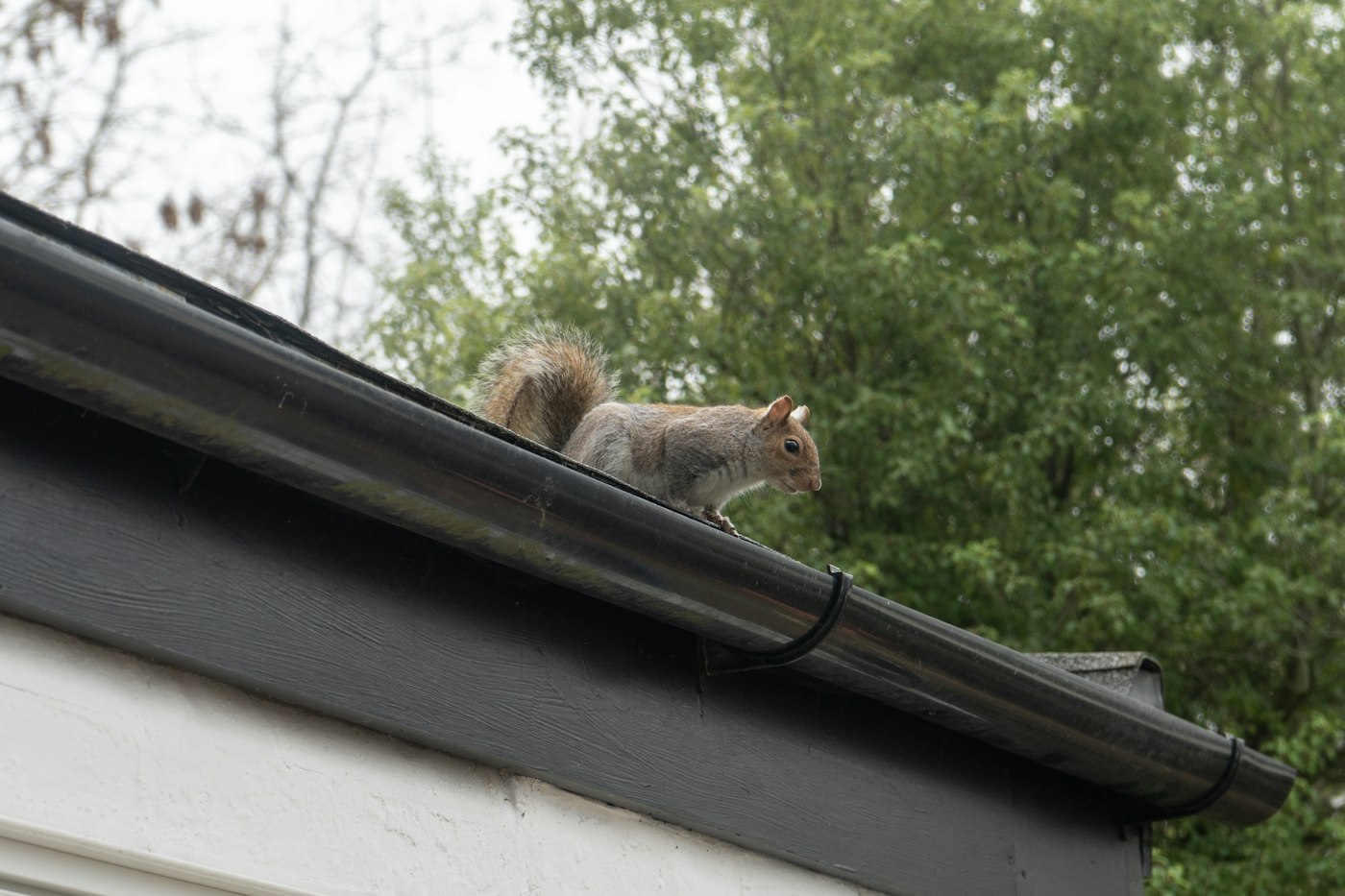
Roof rats and gray squirrels do not come in at ground level. They come in at the top: gable vents with failed screen, the gap where a ridge board meets the sheathing, the open soffit return above a porch roof, a rotted fascia board behind a gutter. Marietta’s mature hardwood canopy makes this easy, because half the houses in the older neighborhoods have limbs touching the roof.
Exclusion beats trapping, and it is not close. Trapping removes the animals currently in the attic. Exclusion — sealing every entry with material the animal cannot chew through, after confirming nothing is left inside — ends the problem. A crew that only sets traps is signing you up for the same visit next October. Ask whether the proposal includes sealing, what material is used, and whether the sealed points are guaranteed.
Trimming limbs back from the roof is the highest-value thing most Marietta homeowners can do themselves. Rodent and wildlife removal across Cobb County.
10 The pest calendar

January to February. The quietest stretch, and the best time to get an inspection and a plan in place before anything is urgent. Operators have calendar space now that they will not have in April.
March to May. Termite swarm season, climbing ant pressure, the first mosquitoes. The busiest period in the trade, and the period when a homeowner is most likely to be sold something under time pressure.
June to August. Peak mosquito and stinging insect season. Heat drives ants indoors looking for water, which is why you often see more of them in a dry spell than a wet one.
September to December. Rodents move toward the building as overnight temperatures drop. Wasps turn aggressive in early autumn as colonies peak and collapse. Termites are the exception to all of it — swarming is seasonal, foraging is not.
11 Choosing a company
When you do not need anyone
Trimming limbs back from the roof, dumping standing water, clearing a blocked crawl vent and pulling mulch back off the siding are all yours to do, and all more effective than most of what gets sold on a first visit.
Georgia requires a license to perform structural pest control. That is the floor, not a recommendation. Above the floor, the differences between companies show up in the proposal long before they show up in the work. Ask these, in this order:
- What is the measured linear footage of my foundation? For termite work this is the whole basis of the job.
- Which product, and is it repellent or non repellent? They should answer without checking.
- Is the warranty retreatment only, or does it include repair? And what is the cap?
- What do years two and three look like, in writing?
- Who does the work — your technician or a subcontractor?
- Will you put the inspection findings in writing, including conducive conditions?
- Is the bond transferable if I sell?
Walk away from: a quote given over the phone without anyone seeing the property; pressure to sign today; refusal to enter the crawlspace paired with a confident opinion about what is under there; a proposal that will not name the product; anyone who cannot explain the difference between the inspection and the bond.
Get two proposals. Not five — two competent ones, read side by side, tell you more than a stack. The full guide to choosing a company.
Every town has its own page. Pick yours and the local detail is already there.
Marietta Kennesaw Acworth Woodstock Mableton Canton Austell Powder Springs Dunwoody
12 Questions
Are you a pest control contractor?
No. We are a referral service. We connect you with a licensed independent company that works your city, and we may be paid a fee for that connection. We do not perform the work ourselves.
Why are there no prices on this site?
The company that does the work sets the figure, and it depends on your foundation, your access, the product and the warranty you choose. Publishing a number nobody here can honor would only mislead you.
How often should pest control be done in Marietta?
Quarterly exterior service is the standard cadence across Cobb County, because there is no genuinely dormant season in north Georgia. Monthly plans make sense for active roach work or heavy pressure properties. Termite protection runs on an annual bond rather than a visit schedule, and is a separate agreement.
Do I actually need termite protection in Cobb County?
Georgia is Termite Infestation Probability Zone 1, the highest-risk rating issued, and Marietta’s housing stock is old enough that most homes have either been treated already or should be. Whether you need treatment right now depends on evidence and on whether an existing bond is in force. An inspection answers it; a sales call does not.
Are the treatments safe around children and pets?
Products registered for residential use are applied under label conditions that assume occupied homes, and most exterior work requires only that people and pets stay off treated surfaces until dry. Interior applications usually have a re-entry interval. Ask for the product name and the label re-entry time in advance, and mention fish tanks and beehives specifically.
Something is in my attic. Trapping or exclusion?
Both, in that order, and exclusion is the part that ends it. Trapping removes what is currently inside; sealing the entry points stops the next one. A proposal that includes trapping but no sealing is a proposal to repeat the visit next autumn.
Read the page first then make the call
Know what is wrong, and what a correct job includes, before a contractor walks in the door.
Jaylan Jones — Cobb County Pest Solutions publishes independent guidance for North Georgia homeowners. We are a referral service, not a licensed pest control contractor, and we do not perform the work. How we work.

